Choosing the right professional video monitor can speed up focus checks, improve color confidence, and make on-set decisions easier.
From compact field displays to large production screens, this roundup focuses on the features that matter most in real workflows.
Best 10 Professional Video Monitor Picks for 2026
Bright Control Monitor
Osee G7 Pro 7'' 3000Nits Monitor

- 3000-nit daylight-friendly display
- Touchscreen camera control on supported models
- 3G-SDI and 4K HDMI I/O with LUT tools
Best For: Outdoor filmmakers who want a bright monitor with camera control
Compact Monitor-Recorder

- 1000-nit 5-inch HDR display
- Records ProRes, ProRes RAW, DNxHR/HD, and HEVC
- Compact build for tripod, handheld, or gimbal use
Best For: Creators who need a compact HDR monitor with recording
Large Broadcast Display
SEETEC 17.3 Inch Broadcast Monitor

- 17.3-inch Full HD monitoring screen
- 3G-SDI, HDMI, DVI, YPbPr, and AV inputs
- Front and rear 3-color tally lights
Best For: Broadcast and event crews needing a large portable monitor
Compact Camera-Control Monitor
Portkeys LH5C 5.4" Field Monitor

- Touchscreen camera control for supported brands
- 800-nit IPS panel with included sunshade
- Waveform, LUTs, false color, and freeze-frame overlay
Best For: Compact-rig shooters who want a small monitor with camera control
Pro HDR Field Recorder
Blackmagic Video Assist 7-inch HDR monitor

- 2500-nit 7-inch display
- HDR with 3D LUT support
- Works with SDI, HDMI, and mini-XLR inputs
Best For: creators who want a bright HDR field monitor with recording support
Budget Field Monitor
FEELWORLD FW759 7-inch HDMI field monitor

- 400-nit 7-inch IPS screen
- 4K HDMI input up to 30Hz
- Focus peaking, false color, and histogram tools
Best For: beginner videographers and vloggers who want a lightweight HDMI monitor
Multi-Camera Director Display
osee Mega 22S4 21.5-inch daylight production monitor
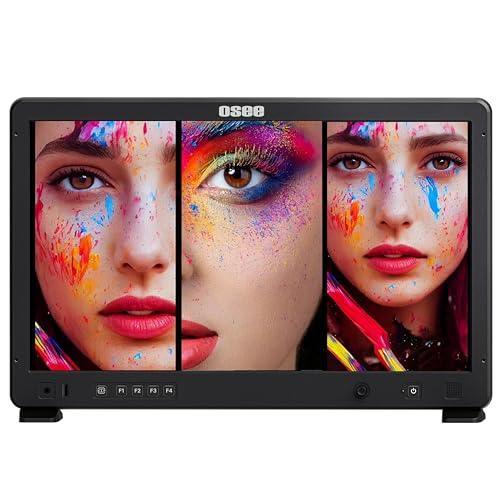
- 1500-nit 21.5-inch Full HD display
- 3 HDMI and 3 SDI inputs with multiview
- Waveform, vectorscope, and custom 3D LUT support
Best For: multi-camera productions that need a bright director-style monitor
Compact Field Monitor
NEEWER F700U 7" OLED camera monitor

- 1200-nit 7" OLED touchscreen
- HDMI loop out plus 3G-SDI I/O
- Includes 2 NP-F750 batteries
Best For: Portable camera monitoring with pro exposure and focus tools
Broadcast Studio Monitor
SEETEC P173-9HSD 17.3" desktop monitor

- 17.3" Full HD desktop display
- 3G-SDI, HDMI, AV, YPbPr, and DVI-I inputs
- Includes tally kit, sunshade, and U bracket
Best For: Studio and broadcast monitoring with a large screen
Large Studio Monitor
FEELWORLD FVM215 21.5" broadcast monitor

- 21.5" 1000-nit bright IPS display
- HDMI and 3G-SDI inputs
- CALMAN calibration with waveform and LUT tools
Best For: Large studio production monitoring with bright, accurate viewing
Bright Control Monitor – Osee G7 Pro 7'' 3000Nits Monitor
If you need a professional video monitor for bright outdoor shoots and on-the-fly camera control, the Osee G7 Pro is built for that workflow. Its 7-inch screen, 3000-nit brightness, and 3G-SDI plus 4K HDMI I/O make it a strong fit for demanding field use, while the touchscreen adds practical control features that can speed up setup and monitoring.
Best For: Outdoor filmmakers and operators who want a bright monitor with touchscreen camera control and advanced analysis tools.
Pros:
- 3000-nit brightness is well suited to daylight shooting without a sunhood.
- Touchscreen camera control supports WB, ISO, aperture, shutter speed, record, and touch focus on supported cameras.
- 3G-SDI and 4K HDMI input/output add flexible connectivity for video workflows.
- Waveform, histogram, vectorscope, false color, and LUT support help with accurate exposure and color checks.
Cons:
- Camera control and touch-focus features depend on supported camera models.
- Camera control requires NP-F battery power, which adds another setup consideration.
- Larger field-monitor form factor is less compact than 5-inch options.
The G7 Pro is a feature-rich choice if you want monitoring, analysis, and camera control in one bright package. It leans toward serious production use rather than minimalist rigs.
Compact Monitor-Recorder – Atomos Ninja V HDR Recorder
The Atomos Ninja V remains a practical professional video monitor for creators who want compact HDR viewing plus recording in one unit. Its 5-inch 1000-nit display is daylight viewable, and the recorder supports common pro formats like Apple ProRes, ProRes RAW, Avid DNxHR/HD, and HEVC over compatible camera connections.
Best For: Filmmakers who want a compact monitor-recorder for HDR monitoring and high-quality capture.
Pros:
- 1000-nit HDR screen is bright enough for many outdoor and run-and-gun setups.
- Records in Apple ProRes, ProRes RAW, Avid DNxHR/HD, and HEVC.
- Compact and lightweight design works well on tripod, handheld, or gimbal rigs.
- Supports record, playback, review, tagging, and playlist creation.
Cons:
- It is a 5-inch display, so it offers less screen area than larger field monitors.
- Some camera compatibility relies on optional accessories.
- It is more focused on recording workflows than on built-in camera control.
For shooters who value a proven monitor-recorder format, the Ninja V still covers the essentials well. It balances portability, HDR monitoring, and professional recording support.
Large Broadcast Display – SEETEC 17.3 Inch Broadcast Monitor
This professional video monitor is aimed more at production rooms, broadcast setups, and event control than at small camera rigs. The 17.3-inch screen, full HD resolution, and multiple professional inputs and outputs make it useful when you need a larger reference display with broad connectivity and a carry-on style design.
Best For: Broadcast teams and production crews needing a large, portable monitor for studio-style workflows.
Pros:
- 17.3-inch display gives you a much larger monitoring area than typical field monitors.
- Supports 3G-SDI, HDMI, YPbPr, DVI, and AV connections.
- Includes front and rear 3-color tally lights for live production use.
- Aluminum carry-on housing helps protect the monitor during transport.
Cons:
- 400-nit brightness is modest for harsh outdoor viewing.
- Its size and carry-case design make it less suitable for compact camera rigs.
- Resolution is 1920×1080, so it is built for monitoring rather than ultra-detailed pixel work.
If your workflow needs a larger, mobile display for switching, broadcast, or event coverage, this SEETEC model fits that role well. It is more of a production station monitor than a lightweight field solution.
Compact Camera-Control Monitor – Portkeys LH5C 5.4" Field Monitor
The Portkeys LH5C is a compact professional video monitor built for creators who want a lightweight monitor with camera control and solid image tools. Its 5.4-inch IPS panel, 800-nit brightness, and included sunshade make it a practical field option, while the touchscreen adds direct control for supported Sony, Canon, and Panasonic cameras.
Best For: Hybrid shooters and compact-rig users who want camera control in a small field monitor.
Pros:
- Touchscreen camera control supports aperture, shutter, ISO, and white balance on compatible cameras.
- 800-nit screen with included sunshade helps with outdoor monitoring.
- Useful tools include waveform, histogram, zebra, audio meters, false color, LUT support, and focus peaking.
- Freeze-frame overlay comparison helps with matching shots and maintaining continuity.
Cons:
- Compatibility is model-dependent, so camera control is not universal.
- 4K input is limited to 4K30p, with 1080p60 output.
- Smaller 5.4-inch screen may feel tight for users who prefer larger monitoring displays.
The LH5C delivers a strong mix of portability and monitoring features for compact production setups. It is especially appealing if you want camera control without moving up to a larger, heavier rig.
Pro HDR Field Recorder – Blackmagic Video Assist 7-inch HDR monitor
Blackmagic Design Video Assist 7" 12G-SDI/HDMI HDR Recording Monitor (HYPERD/AVIDA12/7HDR)
Check Price On AmazonIf you need a professional video monitor that also handles recording, the Blackmagic Design Video Assist 7" 12G-SDI/HDMI HDR Recording Monitor is built for on-set use. Its 7-inch, 1920×1080 screen, 2500-nit brightness, HDR support, and 3D LUTs make it practical for monitoring exposure and color when working with SDI or HDMI camera setups.
Best For: Shooters who want a bright HDR field monitor with recording support for SDI and HDMI rigs.
Pros:
- Very bright 2500-nit display for easier viewing in challenging light
- Supports HDR and 3D LUTs for more detailed image checking
- Works with devices that use SDI, HDMI, or mini-XLR inputs
- Portable 7-inch format for field monitoring
Cons:
- 7-inch screen may feel small for multi-operator viewing
- Single HDMI port limits simple HDMI routing
- Focused on monitoring and recording rather than large-set collaboration
This is a strong fit if you want a professional video monitor with high brightness and HDR tools in a compact, camera-friendly size. It is especially useful when you need accurate image review on location and prefer a monitor that can travel easily with your rig.
Budget Field Monitor – FEELWORLD FW759 7-inch HDMI field monitor
The FEELWORLD FW759 is a practical professional video monitor choice for creators who want a larger external screen without a lot of bulk. It pairs a 7-inch 400-nit IPS panel with 4K HDMI input support and a set of useful viewing tools, making it a straightforward option for DSLR and mirrorless shooting.
Best For: Beginner videographers, vloggers, and small crews who want an affordable HDMI field monitor.
Pros:
- 7-inch IPS display with 1280×800 resolution
- 4K HDMI input support up to 4K@30Hz
- Built-in focus peaking, histogram, false color, and overexposure warning
- Lightweight 300g design with included sunshade for easier rigging
Cons:
- 400-nit brightness is better suited to indoor or controlled-light shooting
- Designed around HDMI setups, not SDI workflows
- Smaller screen and lower resolution than higher-end production monitors
Overall, this monitor makes sense if you want core monitoring tools and a lightweight build at a beginner-friendly level. It is best viewed as a dependable on-camera monitor for framing, focus, and exposure checks rather than a high-brightness broadcast display.
Multi-Camera Director Display – osee Mega 22S4 21.5-inch daylight production monitor
The osee Mega 22S4 is a professional video monitor built for multi-camera production work, especially when you need more than a simple on-camera screen. Its 21.5-inch 1080p panel, 1500-nit brightness, and split-screen viewing modes make it well suited to director, DIT, and client monitoring in bright locations.
Best For: Productions that need a large daylight-viewable monitor with multi-view and broadcast-style inputs.
Pros:
- 21.5-inch Full HD display with 1500-nit brightness for outdoor use
- Supports single, dual, triple, quad, PIP, and PBP split-screen modes
- 3x 4K HDMI and 3x 3G-SDI inputs for flexible source switching
- Includes waveform, vectorscope, false color, focus peaking, and custom 3D LUT support
Cons:
- Large 9.5 kg build is not meant for compact camera rigs
- Best suited to crew setups rather than solo run-and-gun use
- Higher-capacity production monitor may be more than needed for simple shoots
This monitor stands out when the job calls for a larger shared viewing screen and professional signal flexibility. If your workflow includes multiple cameras, outdoor daylight, or client review, it offers a much more capable setup than a typical field monitor.
Compact Field Monitor – NEEWER F700U 7" OLED camera monitor
If you want a professional video monitor that travels well and still gives you serious on-set tools, the NEEWER F700U is built for that job. Its 7-inch OLED touchscreen, 1200-nit brightness, and 1920×1080 resolution make it practical for daylight viewing and detailed framing, while HDMI and SDI support keeps it flexible with camera setups.
Best For: DSLR and mirrorless shooters who need a bright, compact field monitor with advanced exposure and focus tools.
Pros:
- 1200-nit 7″ OLED touchscreen with 1920×1080 resolution and 100000:1 contrast
- HDMI input/loop out plus 3G-SDI input/output for flexible signal routing
- Strong monitoring toolkit: peaking, false color, zebra, waveform, vectorscope, HDR, and audio levels
- Includes 2 NP-F750 batteries and supports USB-C, DC, and NP-F power options
Cons:
- SDI cable is not included
- DC 12V adapter is not included
- Custom LUT workflow depends on using an SD card
Overall, this monitor stands out as a compact, feature-rich option for creators who need real production tools in a portable size. The included batteries and cooling fan also make it easier to use on longer shoots.
Broadcast Studio Monitor – SEETEC P173-9HSD 17.3" desktop monitor
For a professional video monitor used in studio or broadcast environments, the SEETEC P173-9HSD offers a larger 17.3-inch Full HD display with multiple input options. It is designed for desktop-style monitoring, giving production teams a roomy screen plus built-in tools like image freeze and focus assist.
Best For: Studio production, broadcast monitoring, and desk-based video review where a larger screen matters.
Pros:
- 17.3-inch 1920×1080 display with Full HD resolution
- Multiple connections including 3G-SDI, HDMI, AV, YPbPr, and DVI-I
- Includes focus assist, image freeze, built-in speaker, and headphone jack
- Comes with practical studio accessories like tally kit, sunshade, and U bracket
Cons:
- 400 cd/m² brightness is lower than high-bright field monitors
- 80-degree viewing angle is narrower than some newer panels
- Heavier, more desktop-oriented design at 3.3 kg
This is a solid choice when size, connectivity, and broadcast-style workflow matter more than portability. It is especially useful if you need a dependable monitor for a fixed studio or control-room setup.
Large Studio Monitor – FEELWORLD FVM215 21.5" broadcast monitor
If you need a professional video monitor with a bigger viewing area for studio production, the FEELWORLD FVM215 is built around a 21.5-inch 1000-nit screen. The IPS panel, HDMI and 3G-SDI inputs, and built-in focus and exposure tools make it a strong fit for teams that want a clearly visible production display.
Best For: Studio crews and production setups that want a large, bright monitor with color calibration and monitoring tools.
Pros:
- 21.5-inch 1000-nit screen for strong visibility
- HDMI and 3G-SDI connectivity for common pro video workflows
- Includes focus assist, false color, waveform, RGB parade, vectorscope, and 3D LUT loading
- Factory color calibration via CALMAN software for improved color accuracy
Cons:
- Large desktop footprint compared with field monitors
- IPS brightness and color tools may be more than needed for simple monitoring jobs
- Heavier at 9.4 pounds, so it is less travel-friendly
As a production monitor, this model is best when screen size and visibility are priorities. It brings together bright output, calibration, and pro monitoring tools in one studio-friendly package.
How We Picked the Best Professional Video Monitor
We prioritized screen brightness, resolution, input/output options, color tools, touch control, and build quality. For a Professional Video Monitor, the best choice is usually the one that matches your shooting environment and signal chain, not the one with the longest spec sheet.
Quick Comparison
Smaller 5- to 7-inch models are best for camera-top use, focus pulling, and lightweight rigs. Larger 17- to 22-inch displays suit director stations, broadcast carts, studio review, and multi-view monitoring. Recording-capable models add value when you want monitoring and capture in one device.
Key Buying Factors for a Professional Video Monitor
Brightness and Visibility
If you shoot outdoors, daylight-viewable brightness matters more than almost anything else. Higher nit ratings help the image stay readable without relying entirely on a sun hood.
Resolution and Panel Size
Match panel size to viewing distance. A 7-inch monitor is ideal close to the camera, while a larger monitor is easier for teams to judge framing, focus, and exposure from a distance.
Connectivity
Check for the inputs your gear actually uses, such as HDMI, 3G-SDI, or 12G-SDI. Loop-through outputs are useful for passing signal to another monitor, recorder, or wireless transmitter.
Monitoring Tools
Waveform, false color, focus peaking, zebras, and LUT support are essential on a Professional Video Monitor because they help you expose and focus accurately without guesswork.
Power and Mounting
Battery compatibility, USB-C power, and rugged mounting options can matter as much as image quality, especially for run-and-gun production or long studio days.
Who Should Buy Which Professional Video Monitor?
Solo shooters and gimbal users should look for a compact, bright 5- to 7-inch model with touch control and strong focus tools. Indie filmmakers and hybrid creators may prefer a monitor-recorder for a simpler kit. Broadcast teams, directors, and production crews should lean toward larger monitors with SDI, high brightness, and multi-view support. If you need a dependable Professional Video Monitor for mixed use, start by choosing the screen size and connection standard that fits your workflow, then narrow by brightness and tools.