Finding the best smart lock for office access means balancing security, convenient entry, user management, and installation requirements. The right model can replace shared keys while making it easier to control who enters and when.
We compared 10 fingerprint, keypad, app-enabled, and Wi-Fi locks to help you choose a practical fit for a private office, shared workspace, rental suite, or small business.
Best 10 Smart Lock for Office Picks for 2026
Flexible Entry

- Fingerprint, keypad, app, fob, and key entry
- Remote logs and code management with app
- Optional gateway enables remote and voice control
Best For: Small offices and flexible-access workspaces
Connected Control
- Built-in Wi-Fi needs no separate hub
- Flexible temporary and recurring PIN codes
- Fingerprint, app, history, and auto-lock features
Best For: Offices managing scheduled or changing access
Interior Office Pick
- Designed for interior doors including offices
- 0.3-second fingerprint unlocking
- Built-in Wi-Fi and USB-C emergency backup
Best For: Interior office rooms and storage areas
Compact Biometric Access

- Fingerprint, password, IC card, app, and key entry
- Supports up to 100 fingerprints and 50 passwords
- Indoor installation without drilling or wiring
Best For: Indoor office rooms and small shared spaces
Best Wi-Fi Office Pick

- Built-in Wi-Fi with remote app control
- Fingerprint, passcode, and voice entry
- Quick installation for left- or right-hand doors
Best For: Offices needing remote access management and event history
Best Privacy-Focused Knob
4-in-1 Fingerprint Smart Door Knob

- Four entry methods including fingerprint and app
- Offline encrypted biometric data storage
- No-drill installation for compatible wooden doors
Best For: Interior office rooms prioritizing local data storage
Best for Managed Access

- Six entry methods including fob and passcode
- Temporary codes and unlock records in the app
- Optional gateway enables remote Wi-Fi control
Best For: Property managers and offices handling recurring or temporary access
Best No-App Pick

- 20 user and one-time codes
- Auto-lock and passage mode
- No app, Wi-Fi, or Bluetooth
Best For: Small offices needing simple code access
Best Budget Knob

- Up to 20 user codes
- 5–99-second auto-lock range
- Quick screwdriver installation
Best For: Small offices wanting basic PIN entry
Best Connected Option
Philips Wi-Fi Fingerprint Lock

- Five entry methods, including fingerprint
- Up to 100 password codes
- Remote control and activity alerts
Best For: Offices needing connected access management
Flexible Entry – Sifely Fingerprint Smart Lock
For offices that need several ways to enter, this smart lock for office use combines fingerprint, keypad, app, fob, and traditional key access. Its optional Wi-Fi gateway adds remote management, while the reversible handle and no-drilling installation support straightforward upgrades on compatible doors.
Best For: Small offices, rental workspaces, and teams needing flexible access methods.
Pros:
- Supports fingerprint, passcode, app, fob, and key entry.
- App access logs help track users and manage codes remotely.
- Reversible handle and DIY installation suit left- or right-opening doors.
- Works with Alexa and Google Assistant when paired with the optional Wi-Fi gateway.
Cons:
- Remote access and voice control require the optional Sifely Wi-Fi Gateway.
- Compatibility should be checked against the office door before installation.
This is a versatile choice when an office needs multiple entry options and property-manager-style code control. It is particularly practical where remote access matters, provided the additional gateway is acceptable.
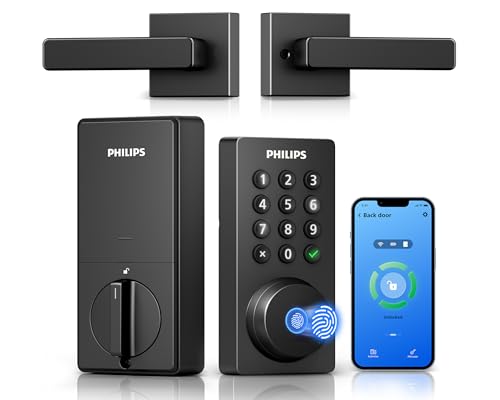
Connected Control – Philips WiFi Keypad Deadbolt
The Philips 4200 Series is a smart lock for office setups that need built-in Wi-Fi and detailed access management without buying a separate hub. Its app supports remote status checks, access history, fingerprints, and several types of PIN codes, while the included handle creates an all-in-one installation.
Best For: Offices that need scheduled, recurring, or temporary access codes.
Pros:
- Built-in 2.4GHz Wi-Fi provides remote control without an extra hub.
- Supports permanent, one-time, periodic, and recurring PIN codes.
- Offers fingerprint unlocking, app control, access history, and auto-lock settings.
- Includes a matching door handle and is designed for screwdriver installation.
Cons:
- It requires a 2.4GHz Wi-Fi connection within the stated 33-foot range.
- Auto-lock is off by default and must be enabled in the app.
- Batteries are not included; the manufacturer specifies standard 1.5V alkaline batteries.
With built-in Wi-Fi and flexible code scheduling, this model is well suited to offices with changing staff, contractors, or recurring visitors. Confirm door thickness and opening direction before installation.
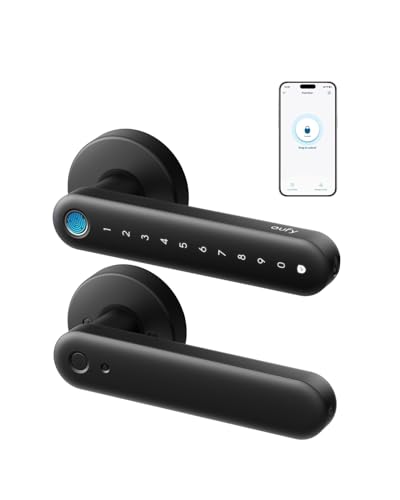
Interior Office Pick – eufy FamiLock C32
The eufy FamiLock C32 is a practical smart lock for office interior doors, such as private rooms, storage areas, and internal workspaces. It combines fast fingerprint access with built-in Wi-Fi, remote authorization, auto-lock, and a USB-C emergency power option.
Best For: Interior office doors, private rooms, storerooms, and garage entries.
Pros:
- Fingerprint unlocking is rated at 0.3 seconds and supports multiple users.
- Built-in 2.4GHz Wi-Fi enables remote management and authorization.
- Four AA batteries provide over five months of stated battery life.
- USB-C emergency backup can provide power from a power bank.
Cons:
- It is not recommended for front doors.
- Rekeying is not supported.
- Its standard fit is intended for interior doors, so compatibility should be verified.
This is one of the more targeted choices for an office because the manufacturer specifically lists office doors and interior applications. Choose it when fast biometric entry and remote management matter more than front-door use or rekeying.
Compact Biometric Access – 5-in-1 Smart Door Knob
This 5-in-1 biometric door knob is a smart lock for office and apartment-style interior doors where several credential types are useful. It supports fingerprints, passwords, IC cards, app control, and mechanical keys, with temporary access and entry-log management through the Tuya app.
Best For: Indoor office rooms, bedrooms, apartments, and small teams needing multiple credential options.
Pros:
- Combines fingerprint, password, IC card, app, and mechanical key access.
- Stores up to 100 fingerprints and 50 passwords according to the supplied notes.
- App supports temporary or permanent access, entry logs, and silent mode.
- Installs without drilling or wiring on compatible wooden doors.
Cons:
- An administrator fingerprint must be registered before first use; otherwise any fingerprint can unlock it.
- The USB port provides emergency power but does not charge the internal batteries.
- It is specified for indoor use and compatible wooden doors, not general exterior applications.
This model offers strong credential flexibility for an indoor office door, especially when app-issued access and IC cards are useful. Follow the administrator setup step carefully before putting it into service.
Best Wi-Fi Office Pick – eufy Security Smart Lock C33
For offices that need remote access and straightforward user management, the eufy Security Smart Lock C33 is a practical smart lock for office doors. Its built-in Wi-Fi supports app control, real-time notifications, access management, and event history, while fingerprint, passcode, and voice controls provide flexible entry options.
Best For: Offices needing Wi-Fi access control, activity records, and fingerprint entry.
Pros:
- Built-in Wi-Fi enables remote control, notifications, and event history.
- Supports fingerprint, passcode, app, and voice unlocking.
- Installs in about 15 minutes without drilling and fits left- or right-hand doors.
- Includes auto-lock, anti-peeping password protection, and a backlit keypad.
Cons:
- Uses 8 AA batteries, so battery status should be monitored.
- Its deadbolt design may not suit every office door configuration.
The C33 is a strong choice when remote visibility matters as much as keyless entry. Its Wi-Fi features are especially useful for managers who need to review access activity or control the door away from the office.
Best Privacy-Focused Knob – 4-in-1 Fingerprint Smart Door Knob
This 4-in-1 fingerprint door knob is a compact smart lock for office interiors where flexible entry and local data storage are priorities. It combines fingerprint, Tuya app, keypad, and key access, with offline biometric storage and Bluetooth connectivity.
Best For: Small offices and private rooms that want multiple entry methods without cloud-stored biometric data.
Pros:
- Offers fingerprint, app, anti-peeping keypad, and emergency-key entry.
- Stores biometric data locally in an encrypted chip according to the supplied notes.
- Stores up to 100 fingerprints, codes, or cards.
- Installs without drilling or wiring on compatible 1.18- to 1.97-inch wooden doors.
Cons:
- Uses Bluetooth rather than built-in Wi-Fi for connectivity.
- Compatibility is limited to wooden doors within the stated thickness range.
- Its privacy lock design may be better suited to interior office rooms than exterior entrances.
Choose this model when a simple door-knob replacement and offline biometric storage are more important than remote Wi-Fi operation. Silent mode and five-second auto-lock also make it suitable for quieter work areas.
Best for Managed Access – Yamiry Smart Door Handle Lock
The Yamiry Smart Door Handle Lock is a versatile smart lock for office use when administrators need several entry options and app-based access management. It supports fingerprints, passcodes, key fobs, mechanical keys, Bluetooth, and optional Wi-Fi gateway functionality for remote control.
Best For: Landlords, property managers, and offices that issue temporary or recurring access credentials.
Pros:
- Provides six access options, including fingerprint, app, passcode, fob, key, and voice control.
- App supports permanent or temporary access, one-time passcodes, and unlock records.
- DIY installation takes about 10 minutes using a screwdriver on compatible doors.
- Includes passage mode, auto-lock, two key fobs, and two mechanical keys.
Cons:
- Remote Wi-Fi control requires a separately sold gateway.
- Bluetooth is built in, but remote features depend on the additional gateway.
- Compatibility is described primarily for standard American wooden doors.
This Yamiry model stands out for access administration rather than just keyless entry. Its temporary-code and unlock-record features can simplify staff, tenant, or visitor access, provided the optional gateway is added when remote operation is needed.
Best No-App Pick – Keypad Handle Lock
If you need a smart lock for office access without managing an app, Wi-Fi, or Bluetooth, this keypad handle lock keeps entry straightforward. It supports up to 20 personalized codes, one-time codes, automatic locking, and a passage mode for busy periods.
Best For: Small offices, rentals, and interior or exterior doors where code-based access and simple installation matter more than remote control.
Pros:
- Stores up to 20 personalized 4–8 digit codes, including temporary one-time codes.
- Offers adjustable auto-lock timing from 5 to 99 seconds plus passage mode.
- Installs with a screwdriver in about 15 minutes and includes two backup keys.
- Provides a backlit keypad, low-battery alerts, and IP54 weather resistance.
Cons:
- No app, Wi-Fi, or Bluetooth connectivity for remote management or activity logs.
- Uses four AA batteries, which are not included.
This is a practical office entry option for users who want shared PIN access without connected-home complexity. Its code capacity and passage mode are useful for routine staff access, while the physical keys provide a backup.
Best Budget Knob – Yamiry Keypad Door Knob
For a straightforward smart lock for office doors, the Yamiry keypad knob combines code entry with a familiar knob design. It supports 20 user codes, backup keys, adjustable auto-locking, and installation with only a screwdriver.
Best For: Smaller offices or front-door applications that need basic keypad entry without a more advanced remote-access system.
Pros:
- Supports up to 20 codes and a simple 4–8 digit programming format.
- Allows auto-lock timing from 5 to 99 seconds or can remain unlocked.
- Includes two backup keys and installs in less than 15 minutes with a screwdriver.
- Has a backlit keypad, low-battery indicator, anti-prying code feature, and IP54 weather resistance.
Cons:
- The supplied information does not describe app-based remote control or activity logging.
- Its listed connectivity details are inconsistent, so confirm compatibility before purchase.
- The included service coverage is one year, with a 30-day money-back guarantee.
The Yamiry is best viewed as a basic electronic code lock rather than a fully connected office-access platform. It can suit a small workplace where shared PINs and easy installation are the main priorities.
Best Connected Option – Philips Wi-Fi Fingerprint Lock
If you want a smart lock for office access with remote oversight, the Philips model adds fingerprint entry, Wi-Fi app control, alerts, and detailed event logs. It supports up to 50 fingerprints and 100 password codes, making it the most configurable option in this group.
Best For: Small businesses, offices, rentals, and teams that need multiple entry methods, remote control, and visibility into door activity.
Pros:
- Offers fingerprint, app, password, voice, and physical-key entry methods.
- Supports up to 50 fingerprints and 100 password codes, including scheduled or temporary codes.
- Built-in 2.4GHz Wi-Fi enables remote locking, unlocking, push alerts, and activity logs without a hub.
- Provides adjustable 5–180-second auto-locking plus passage and privacy modes.
Cons:
- Its connected features depend on Wi-Fi, the Philips HomeAccess app, and compatible voice assistants.
- The supplied notes do not specify complete installation compatibility details for every door.
- It offers more setup and management complexity than the non-connected keypad options.
This is the strongest choice when an office needs more than local PIN entry. Fingerprint access can speed up daily entry, while remote controls, alerts, and logs give managers greater visibility over access events.
How We Picked the Best Smart Lock for Office Use
We focused on the features that matter in everyday commercial and professional spaces: dependable entry methods, access-code capacity, fingerprint recognition, remote control, auto-lock behavior, power requirements, emergency access, and installation difficulty. We also considered whether each lock requires Wi-Fi or an app, since some offices want remote management while others prefer a self-contained keypad.
Product descriptions and listed specifications were compared for access flexibility and practical setup. Because door thickness, backset, lock type, and local security requirements vary, verify compatibility before ordering.
Quick Comparison
| Lock type | Best for | Wi-Fi/app | Primary access options |
|---|---|---|---|
| Fingerprint and keypad | Fast employee entry | Varies | Fingerprint, code, key |
| Wi-Fi smart locks | Remote management | Yes | App, fingerprint, code, key |
| Keypad-only locks | Simple shared access | No | Code and key |
| Multi-method locks | Flexible households or teams | Varies | Fingerprint, app, code, card, key |
Key Buying Factors for a Smart Lock for Office
Access Management
Choose individual codes or app-based user management if several employees need access. A lock supporting multiple passcodes is more practical than one shared code, since you can remove a departing user without changing everyone else’s credentials.
Remote Control and Connectivity
Built-in Wi-Fi is useful for checking status, locking the door remotely, creating temporary codes, or managing access while away. However, Wi-Fi models depend on network availability and may require account setup. A no-app keypad can be the better choice for a small office that only needs local entry.
Entry and Backup Options
Fingerprint access is fast, while keypads work well for visitors and teams. Keep a physical key, emergency power method, or other backup available in case batteries fail or electronics malfunction. Confirm whether fingerprints and codes work reliably with the door’s normal alignment.
Installation and Door Compatibility
Check the lock format, door thickness, backset, handle orientation, and whether your door uses a knob, lever, or deadbolt. Easy-install models can still require accurate measurements and a properly aligned latch. For an exterior office door, also consider weather exposure and the manufacturer’s security specifications.
Battery Life and Auto-Lock
Auto-lock helps prevent accidental access, but set the delay carefully so employees are not locked out during busy periods. Select a model with clear low-battery warnings and maintain a replacement schedule.
Who Should Buy Which Smart Lock for Office?
- Choose a Wi-Fi fingerprint model if you need remote access, app controls, activity features, or temporary credentials.
- Choose a fingerprint-and-keypad lock for teams that want quick daily entry without carrying keys.
- Choose a multi-method lock if employees, contractors, or guests need different ways to enter.
- Choose a no-Wi-Fi keypad lock for a simple private office, backup entrance, or installation where internet access is limited.
For most small businesses, the best Smart Lock for Office use is the one that matches the access workflow rather than offering the longest feature list. Prioritize user control, dependable backup entry, and verified door compatibility before choosing advanced connectivity.